1909-S VDB Wheat Penny Value Guide How Much Is Yours Really Worth
The 1909-S VDB Lincoln Wheat Penny is worth anywhere from $600 in heavily worn condition to well over $100,000 for a pristine mint-state example — making it one of the most valuable pennies any American collector or casual coin finder could ever stumble upon.
If you recently dug an old penny out of a drawer or inherited a coin collection and spotted a tiny “S” under the date and “VDB” on the back, you may be holding something extraordinary. Before you do anything else, try using a free coin identifier app to get a quick first look at what you have. Then read on — because the details matter enormously with this coin.
—
What Makes the 1909-S VDB Wheat Penny So Special
The 1909-S VDB Lincoln Wheat Penny is legendary in the coin collecting world, and for good reason. When the Lincoln cent debuted in 1909, designer Victor David Brenner had his initials — “VDB” — placed prominently on the reverse of the coin. The public complained the initials were too conspicuous, and the U.S. Mint quickly pulled them from production. This meant only a limited number of coins were struck before the change was made.
At the Philadelphia Mint, over 27 million VDB pennies were made — common enough that they’re worth far less today. But at the San Francisco Mint, identified by the “S” mintmark, only 484,000 were produced before the presses stopped. That’s an incredibly small number for a circulating coin. Low mintage combined with high collector demand has pushed values sky-high for over a century. The CoinKnow app database lists this coin as one of the top 10 most sought-after Lincoln cents of all time — and it’s easy to see why.
—
How to Identify Your 1909-S VDB Penny
Identifying this coin correctly is critical, because fakes and altered dates do exist. Here’s what to look for:
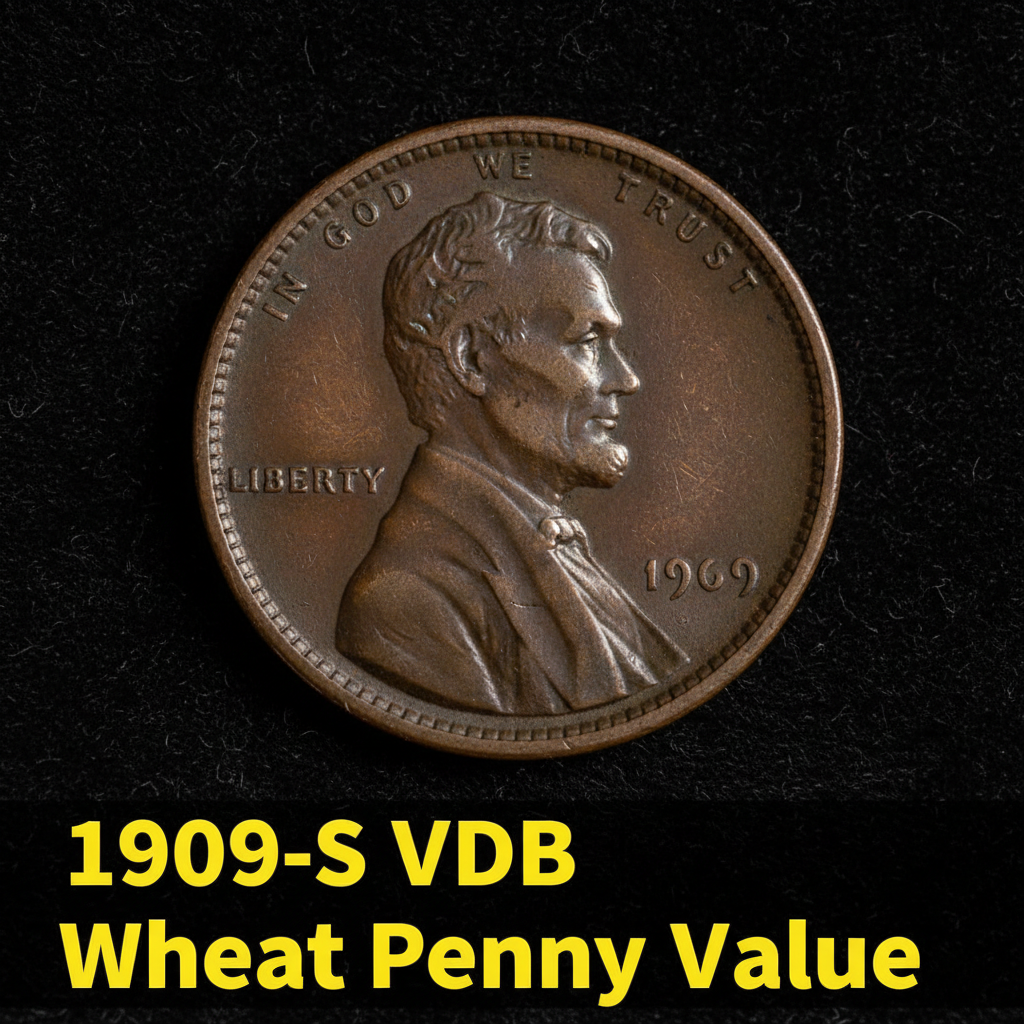
– Date: “1909” on the obverse (front), just below Lincoln’s portrait
– Mintmark: A small “S” directly below the date — this is the San Francisco mint mark
– Designer initials: “VDB” on the reverse, centered at the very bottom between the two wheat stalks
The “S” mintmark must be present. A 1909 VDB penny without the “S” (Philadelphia issue) is worth only $10–$25 in worn condition — a massive difference. Some dishonest sellers have added fake “S” mintmarks to Philadelphia coins, so if you’re serious about authentication, always get the coin professionally graded by PCGS or NGC. Using CoinKnow can help you compare images and spot key details before spending money on grading.
—
1909-S VDB Wheat Penny Value by Grade
The condition of your coin — called its “grade” — is the single biggest factor in determining its value. Here’s a breakdown of what you can expect across different grades:
| Grade | Description | Estimated Value |
|---|---|---|
| Good (G-4) | Heavy wear, all major details visible | $600 – $800 |
| Fine (F-12) | Moderate wear, clear lettering | $900 – $1,200 |
| Extremely Fine (EF-40) | Light wear on high points only | $1,500 – $2,500 |
| About Uncirculated (AU-55) | Slight wear, much original luster | $3,000 – $5,000 |
| MS-63 Red | Uncirculated, strong red color | $15,000 – $30,000 |
| MS-65 Red | Gem uncirculated, vibrant red | $50,000 – $100,000+ |
For a closer look at current market pricing across all grades, you can check out the latest 1909-S VDB Wheat Penny price data by grade and mint state — it’s regularly updated with real auction results.
—
What Affects the Value Beyond Grade
Even two coins with identical grades can sell for very different prices. Color designation is a major factor for uncirculated examples. Lincoln cents in mint state are classified as Red (RD), Red-Brown (RB), or Brown (BN). Red coins retain their original copper brilliance and command the highest premiums — sometimes double or triple the price of a Brown example in the same grade.
Strike quality also matters. Some 1909-S VDB pennies were weakly struck, especially around Lincoln’s hair and the wheat stalks. A sharply struck coin is always worth more. Surface quality — absence of cleaning, scratches, or environmental damage — plays a huge role too. Cleaned coins are heavily discounted by collectors and grading services.
For a comprehensive breakdown of 1909 VDB penny values across different conditions and variants, including comparison between the Philadelphia and San Francisco issues, that resource is worth bookmarking.
—
Should You Sell, Hold, or Get It Graded?
If you believe you have a genuine 1909-S VDB Wheat Penny, the most important first step is to avoid cleaning it — even a gentle rinse can destroy collector value. Next, store it in a soft coin flip or hard plastic holder away from humidity.
Getting it professionally graded by PCGS or NGC is strongly recommended for any coin in Fine condition or better, given that even mid-grade examples are worth well over $1,000. The grading fee is modest compared to the value you’re protecting, and a certified coin is far easier to sell at full market price.
You can also use CoinKnow to track recent auction sales and get a real-time sense of what buyers are paying before you commit to selling.
—
FAQ
Q: How do I know if my 1909 penny is the valuable S VDB version?
A: Look for two things: the “S” mintmark below the date on the front of the coin, and the letters “VDB” centered at the bottom of the reverse between the wheat stalks. Both must be present. If you only have “VDB” but no “S,” it’s a Philadelphia issue worth much less.
Q: Can a 1909-S VDB penny be fake or altered?
A: Yes. Some fakes involve adding an “S” mintmark to a common 1909 VDB Philadelphia penny. Professional grading by PCGS or NGC is the only reliable way to confirm authenticity. Look for inconsistencies in mintmark style, placement, and depth compared to authenticated examples.
Q: Is it worth getting my 1909-S VDB Wheat Penny graded even if it’s worn?
A: In most cases, yes. Even a heavily worn example in Good (G-4) condition is worth $600 or more. A certified, authenticated coin in any grade will sell more easily and for a better price than a raw, unverified one. The grading cost is a worthwhile investment.