1960 Lincoln Penny Value Guide Small Date vs Large Date and What Yours Is Worth
The 1960 Lincoln Penny is worth anywhere from face value in heavily circulated condition to over $100 or more in pristine uncirculated grades — and the key to unlocking that value lies in one important detail: whether you have a Small Date or a Large Date variety.
If you’ve got an old penny from 1960 sitting in a jar or coin roll, you’re in the right place. This guide will walk you through everything you need to know about identifying your coin and figuring out what it’s worth. A quick tip before we dive in: using a free coin identifier app can help you get a fast, accurate read on your coin before you take it to a dealer. And if you want a more comprehensive identification and value tool, CoinKnow is a top-rated app that coin collectors across the country trust for quick, reliable results.
—
How to Tell the Difference Between the 1960 Small Date and Large Date
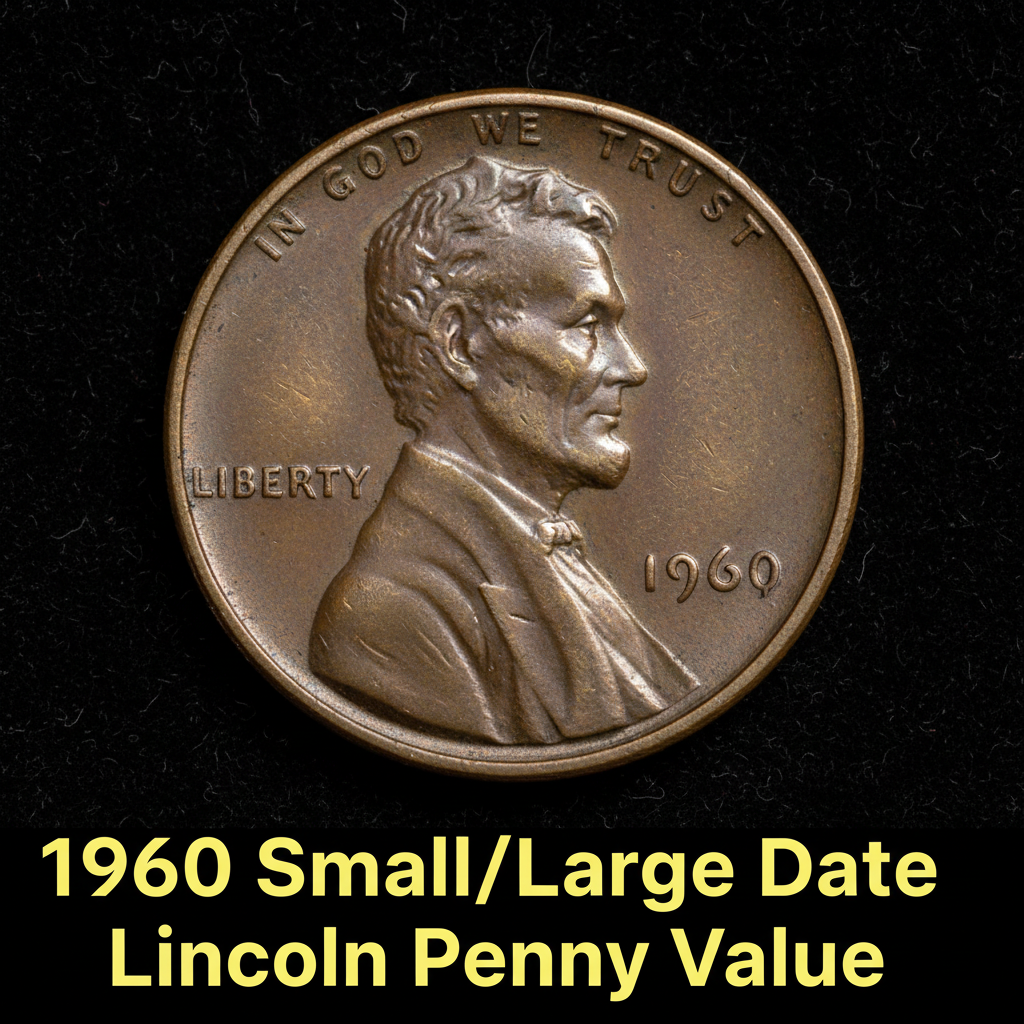
This is the most important step. Both the Philadelphia and Denver Mints produced Small Date and Large Date varieties in 1960, making it one of the more interesting years in the Lincoln Memorial cent series.
Here’s what to look for:
Large Date: The digits of “1960” appear tall and bold, nearly filling the date area. The “9” in particular has a rounded, full appearance and sits close to the top of the numbers. The “0” at the end is circular and prominent.
Small Date: The digits appear slightly smaller and more spaced out. The “9” looks a little more open or elongated, and the top of the “1” is noticeably lower compared to the rest of the numerals. The “6” also appears to sit a bit lower than in the Large Date version.
A magnifying glass or loupe (10x is ideal) makes this comparison much easier. Side-by-side photos online can also be a huge help if you’re new to this. Once you know which variety you have, you’re ready to figure out the real value.
—
1960 Lincoln Penny Value by Variety and Condition
Condition matters a lot when it comes to coin values. A heavily worn penny that’s been in circulation for decades is worth far less than one that’s been carefully preserved. Here’s a breakdown of approximate values for each variety:
| Variety | Good (G) | Fine (F) | Extremely Fine (EF) | Uncirculated (MS) |
|---|---|---|---|---|
| 1960 Large Date (Philadelphia) | $0.05 | $0.10 | $0.25 | $2–$15+ |
| 1960 Small Date (Philadelphia) | $0.25 | $0.50 | $1.00 | $10–$75+ |
| 1960-D Large Date (Denver) | $0.05 | $0.10 | $0.25 | $2–$12+ |
| 1960-D Small Date (Denver) | $0.15 | $0.35 | $0.75 | $5–$40+ |
For top-tier certified examples, values can climb even higher. You can check up-to-date auction and retail price data for the 1960 Large Date Lincoln Penny in MS Red condition to see what top-grade examples are actually selling for right now.
—
Why the Small Date 1960 Penny Is More Valuable
The Small Date variety is rarer than the Large Date, plain and simple. When the U.S. Mint began production in 1960, they initially used a Large Date hub. The Small Date was introduced later in the year, and fewer of them were struck before mintage continued with the more common Large Date design. Because collectors have known about this variety for decades, demand has stayed consistently strong.
In uncirculated condition, a 1960 Philadelphia Small Date penny graded MS-65 Red by PCGS or NGC can sell for $50 to well over $100 at auction. Denver Small Date examples are slightly more common but still carry a nice premium over circulated examples. If you think you might have a Small Date, it’s worth getting it looked at more closely.
For a more detailed look at the full value breakdown of the 1960 penny across all grades and mint marks, there are some excellent resources available online that break down historical sales and current market trends.
—
Proof Coins and Special Strikes From 1960
Don’t overlook proof coins if you found your 1960 penny in an old collector set. The Philadelphia Mint produced proof Lincoln cents in 1960, and these were sold directly to collectors as part of annual proof sets. Both Small Date and Large Date proof versions exist.
A 1960 proof penny in perfect PR-65 condition is generally worth $5 to $20. However, a 1960 Small Date proof can fetch significantly more — sometimes $50 or higher — especially in Deep Cameo grades where the design shows a sharp frosted contrast against a mirror-like background. If your coin has an almost glass-like surface and razor-sharp detail, you may be looking at a proof coin rather than a regular business strike.
CoinKnow makes it easy to distinguish between proof and business strike coins using your phone’s camera — a great tool if you’re sorting through an old collection and aren’t sure what you’re holding.
—
FAQ
Q: How do I know if my 1960 penny is a Small Date or Large Date?
A: Look at the size and spacing of the date digits with a magnifying glass. On the Large Date, the numbers are tall and bold, nearly filling the date area. On the Small Date, the digits are slightly smaller, and the “9” has a more open look. The top of the “1” also sits lower on the Small Date. Comparing your coin to reference images side by side is the easiest method.
Q: Is a 1960 penny with a “D” mint mark worth more?
A: Not necessarily more overall — it depends on the variety and condition. The Philadelphia Small Date is generally considered the most valuable of the business strike coins. Denver examples are slightly more common, but a high-grade 1960-D Small Date in MS-65 or better can still bring a solid premium. Always check the variety first before assuming the mint mark alone adds significant value.
Q: What’s the best way to find out exactly what my 1960 Lincoln penny is worth today?
A: Start by identifying the variety (Small Date vs Large Date) and checking the condition honestly. Then compare to recent auction results online. For a quick estimate right from your phone, CoinKnow gives you real-time coin valuations and helps you identify varieties with ease — a handy tool whether you’re a beginner or a seasoned collector.