1867 Indian Head Penny Value What Yours Could Be Worth
The 1867 Indian Head Penny is worth anywhere from $15 in heavily worn condition to well over $300 in higher mint state grades. If you recently found one of these old copper coins in a drawer or collection, you may be sitting on a surprisingly valuable piece of American history.
If you’re not sure what you have, a free coin identifier app can help you quickly recognize the coin and get a general sense of its grade and value before you dive deeper into research.
—
A Brief History of the 1867 Indian Head Penny
The Indian Head Penny was designed by James Barton Longacre and first struck in 1859. By 1867, the United States Mint in Philadelphia was producing these coins in large numbers to meet post-Civil War demand. The 1867 issue had a mintage of approximately 9,821,000 coins — a decent number, but enough time has passed that well-preserved examples are increasingly hard to find.
The obverse features Lady Liberty wearing a Native American headdress, while the reverse displays a wreath of oak leaves with a shield at the top and the denomination “ONE CENT” in the center. These coins were struck in 95% copper and 5% tin and zinc, giving them a warm reddish-brown tone that deepens with age.
Because so many of these coins circulated heavily through the late 1800s, finding a sharp, uncirculated example today is genuinely rare. That’s what drives collector demand — and value — for this particular date.
—
What Is the 1867 Indian Head Penny Worth Today?
The value of your 1867 Indian Head Penny depends almost entirely on its condition, or grade. Coins that have been worn smooth from years of pocket use are worth much less than those that were carefully stored. Here’s a general breakdown of current market values:
| Grade | Description | Estimated Value |
|---|---|---|
| Good (G-4) | Heavy wear, outline visible | $15 – $20 |
| Very Good (VG-8) | Major details visible, moderate wear | $25 – $35 |
| Fine (F-12) | Moderate wear, most details clear | $40 – $55 |
| Very Fine (VF-20) | Light wear on high points | $65 – $90 |
| Extremely Fine (EF-40) | Slight wear, sharp detail | $110 – $145 |
| About Uncirculated (AU-55) | Trace wear only | $160 – $200 |
| Mint State (MS-63) | Uncirculated, minor blemishes | $275 – $350 |
| Mint State Red (MS-65 RD) | Gem uncirculated, full red luster | $900+ |
For a more detailed look at the 1867 Indian Head Penny’s value across all mint state grades and color designations, professional pricing databases can give you real auction results and certified sale prices.
—
The 67/67 Overdate: A Special Variety Worth Knowing
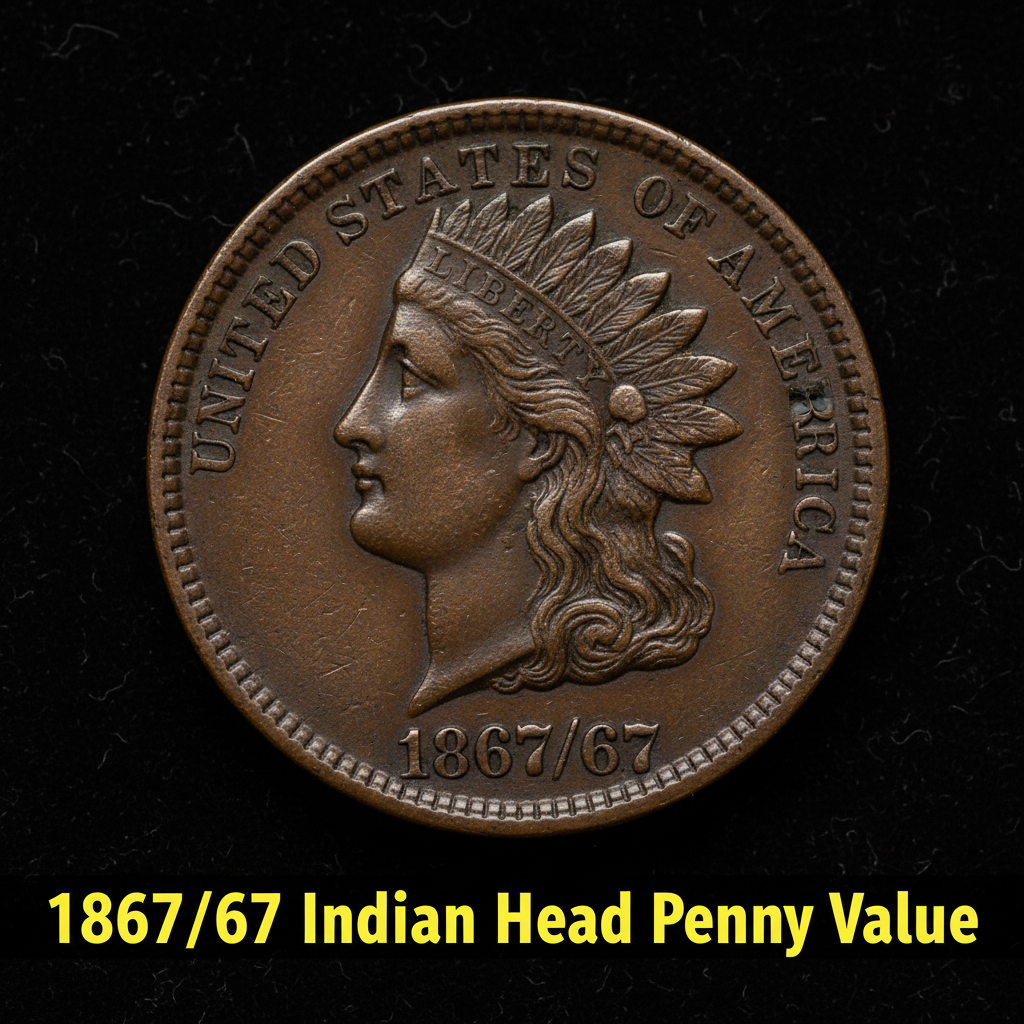
One of the most exciting aspects of the 1867 Indian Head Penny is the existence of the 1867/67 overdate variety. This was created when a die engraved with the last two digits “67” was re-punched over a previously dated die — resulting in a faint doubling of the date numerals that is visible under magnification.
This variety is noticeably more valuable than a standard 1867 cent. In circulated grades like Fine or Very Fine, an authenticated 1867/67 overdate can fetch $75 to $150 more than a regular example. In higher grades, the premium grows even larger, with some certified specimens selling for significantly more at major coin auctions.
If you think your coin might show a doubled or repunched date, examine the “67” portion closely with a 5x or 10x loupe. You’ll be looking for a shadow or ghost image of the digits beneath the final strike. Varieties like this are exactly why it pays to look carefully before assuming your coin is just a common date.
CoinKnow is a great tool for quickly identifying varieties like this — it can scan your coin and flag potential overdates or doubled dies before you decide whether professional grading is worth the investment.
—
How Condition and Color Affect the 1867 Indian Head Penny Value
When it comes to Indian Head Pennies, collectors pay close attention to both grade and surface color. Uncirculated coins are categorized as Brown (BN), Red-Brown (RB), or Red (RD) — and the difference in value between these designations can be dramatic.
A brown uncirculated example might sell for $275, while the same coin with full original red luster could be worth three to four times that amount. Red coins are rare because copper naturally oxidizes over time, so finding one that has retained its original mint color after 150+ years is exceptional.
Color aside, surface quality matters too. Coins with scratches, cleaning, or environmental damage are often worth significantly less, even if they appear bright. The numismatic community strongly discourages cleaning old coins — a cleaned 1867 Indian Head Penny will lose much of its premium, even in high grades.
For a broader perspective on how Indian Head Penny values shift across different dates, you can also explore detailed value information for other Indian Head Penny dates like the 1898 issue to see how condition and demand factors compare across the series.
—
Tips for Selling or Getting Your 1867 Penny Appraised
If you believe your 1867 or 1867/67 Indian Head Penny has significant value, here’s what to do next:
– Don’t clean the coin. Even gentle cleaning can reduce value by 50% or more.
– Get a professional grade. Services like PCGS or NGC will authenticate and grade your coin, which makes it easier to sell and often increases buyer confidence.
– Use trusted marketplaces. eBay, Heritage Auctions, and Stack’s Bowers are popular platforms for selling graded coins.
– Download CoinKnow to get an instant estimate and see how comparable coins have sold recently. CoinKnow pulls real market data so you’re never guessing when it’s time to make a decision about your collection.
—
FAQ
Q: What makes the 1867/67 Indian Head Penny different from a regular 1867?
A: The 1867/67 is an overdate variety — a die was punched with the digits “67” over a previously engraved date, leaving a faint doubling in the date area. This variety commands a significant premium over standard 1867 examples, especially in higher grades.
Q: How do I know if my 1867 Indian Head Penny has been cleaned?
A: Cleaned coins often have an unnatural brightness, hairline scratches visible under magnification, or a flat, dull tone that lacks the depth of original luster. If the coin looks “too shiny” for its age, it may have been polished or wiped at some point.
Q: Is a worn 1867 Indian Head Penny still worth keeping?
A: Absolutely. Even in Good or Very Good condition, a genuine 1867 Indian Head Penny is worth $15 to $35 to collectors. If it turns out to be the overdate variety, the value goes up considerably. It’s always worth having old coins properly identified before passing them along.